Showing posts with label RFSFireup2012. Show all posts

22 June 2012

Commissioner interviewed about community engagement

We are sharing interviews on community engagement with key people in the NSW Rural Fire Service (RFS) on the Building Community Resilience blog.


Commissioner Shane Fitzsimmons AFSM


 This interview is with NSW RFS Commissioner Shane Fitzsimmons AFSM.

1. Why does the NSW RFS do community engagement?
The Rural Fire Service is in the business of community engagement because it is a key part of the fire management package.
'You can’t have a well informed and a well serviced community if you don’t engage meaningfully in educating that community."
More importantly we should be engaging them in doing their part to help improve their personal safety, as well as the safety of the community, the RFS and other Emergency Service agencies.


2. Did the Victorian fires change our approach to working with communities? If yes, how?

Nationally we certainly learnt from that tragedy. We came together in a very, very short time period and realised the need for more concise, more simplified, and more consistent language to alert people to their vulnerability and to make sure at risk communities understand they have a key role in managing fire.

It has certainly strengthened our approach in many areas. There have been changes to the way we communicate public information during fire events. We have also started to prepare local community protection plans where we profile local communities and seek to tailor solutions or treatments that will work best for them.

There is no doubt that the Victorian experience has seen us take a more proactive approach to community engagement and initiatives like Neighbourhood Safer Places and Community Protection Plans. We have ‘one stop shop’ information in our customer service centres to assist Districts and community members and we have improved accessibility to online tools. These tools will help people to understand their level of exposure and the sort of things they should be doing to prepare for and better protect themselves from fire.

Before the Victorian fires NSW was doing very well when it came to development control, planning assessments and building in bush fire prone areas. Our integrated fire fighting and state emergency management arrangements made everyone’s responsibilities very clear. The enormity of the Victorian tragedy mandated that we all needed to do more – and we have.


3. How could members encourage their brigades to get involved in community engagement activities?

I see some wonderful community engagement programs at brigade level across NSW and I think we need to continue to market and promote the positive results and the initiatives being done by individual brigades. Increasingly at the Annual General Meeting there are individuals, or a number of individuals, identified and voted in as Community Engagement Coordinators for their areas and it is being recognised as an important role in local brigades.

Depending on your brigade and your classification as a brigade your community engagement activity will vary considerably. What occurs in a village type brigade or a remote rural brigade will obviously be somewhat different because of the population or geography. Leveraging off each other, seeing what other people are doing, seeing what other brigades are doing, accessing some of the community engagement resources and better understanding what sort of things you can do as a brigade is really important.


There are many roles for Brigade members (Penrose Brigade)
 "We are being very deliberate in looking at our flexible membership model. We need to have more recognition of the importance of non traditional fire fighting roles. Having a well informed and a well prepared community is equally important to fire fighting. Recognising the equality, importance and value of community engagement at an organisational level is really important."


4. How can we encourage our members to share their good stories?

We have members across the state that are doing wonderful things everyday but they don’t gloat about them, they don’t put their hands up and say we have a wonderful thing going on, they just do it.

We usually rely on District Managers and other senior people of the District to say, “hey there’s a good thing happening in our area”, simply because a lot of community engagement people aren’t inclined to promote what they do. They may regard it as everyday business whereas someone else may see it as worth talking about. The community engagement forums are effective in sharing and exchanging ideas with other community engagement people, but how much of that goes out to the broader organisation is unknown.

It’s the same for any of our focus areas, for example our aviation people know what’s new and happening in the Aviation business, but I suspect there are many in the organisation that wouldn’t have a clue. We should be targeting this wider audience as well.

We are looking at a new newsletter that will introduce new and wonderful things going on across the State. There will be news snippets and if people want to read more about a particular note, they will be able to click onto a hyperlink and read a more detailed story about what the brigade or member is doing.


5. What is your opinion on people that want to join a brigade and don’t want to qualify for Basic Fire-fighter (BF), but would like to undertake a support role?

"I have been outspoken about this for a long time now and I think it is critical to our future. We need to advertise and promote the Flexible Membership Model, which values and recognises so many other roles in our organisation other than fire fighting."

The classic example I would use is from a Brigade close to home about 5-6 years ago. Every time there was a bad fire weather day, the local brigade was relied upon to send crews up to the top of the fire tower. They kept a visual out for smoke and then radioed reports back as an early detection system. The local Captain there at the time questioned why he was sending crews up the tower on bad fire days when in fact he needed fire fighters on the truck in case a fire started.

The Brigade put a little note in the local community newsletter, asking residents if they would like to play an important role in the RFS. They asked if anyone wanted to volunteer to assist their community and the RFS but didn’t want to get involved with actual fire fighting. They just needed to undertake some basic fire awareness training and not be afraid of heights, do some training in map reading, radios, etc.

The Brigade was inundated with people that wanted to do something different. There were retired members who had stopped fire fighting and people who have always wanted to get involved but were fearful of the fire fighting. They came on board and did their training courses on map reading and how to use a radio, some basic fire knowledge (wind effect on smoke, etc). They became a Tower Brigade and the tower is staffed regularly every time there is a TOBAN or a bad weather day and it all comes without having to compromise the fire fighting workforce.

I am a big supporter for making sure we continue to diversify roles and recognise diversification of roles and functions in this organisation. There is an old adage in the military that says something like “for every person out in the field holding the rifle, there are three to five other people doing really important roles to make sure that soldier is serviced, protected and looked after”. We are no different and we have an army of people that need to come together, whether it’s catering, community engagement, communications, fire protection, mitigation or technologies, and I am a very big supporter of it.


6. Do you think brigades would benefit from having community engagement training in areas such as our key messages and products such as Neighbourhood Safer Places?

I think it’s critically important. It should be done as part of brigade training and brigade familiarisation. Also at certain times of the year we could update everybody on the key messages and send some posters or fact sheets out to the stations to hang on the walls, carry in their pockets, as well as having them all available on MyRFS. Then everyone has a quick reference point.

I remember very vividly one of the skits at a previous Community Engagement Conference at Newcastle where they did role plays. Members in the role play weren’t quite aware of what the messages were and the poor community member was trying to get from fire fighters what the message meant. If our fire fighters don’t have knowledge and make it up, dismiss or belittle the information, then the whole thing is lost and we lose a good opportunity to help make people safer.


7. Are there any groups in the community that are a priority to engage with?

It is obviously a priority to engage with those that live, work or travel in bush fire prone areas, but particularly we need to look at our vulnerable community members. We need to look at what options are available to them and what treatments can be delivered. I think we will benefit from the new work we are doing on Community Protection Plans. They will enable us to take a more detailed look at our communities and work more closely with them. Part of the benefits of delivering Community Protection Plans is working with Brigades and community members to identify their risks and what treatments are available, and what individuals can do on their property or when working as a collective with neighbours.


Workshopping Community Protection Plans at the 2012 ACE&FA Conference
 We have just been through the two wettest successive years on record in NSW. With all that moisture, which is very widespread, we have an abundance of grassland growth the likes of which we have not seen for 30-40 years. In some areas that 30-40 years difference is a generational change and you’re dealing with people that will have very limited experience of fire in their area. For the last 20 years with extraordinary, protracted drought situations the risk has been moderated significantly by the absence of fuel on the ground. We have to take a good look at grassland communities.


8. How do you think a history of doing community engagement with a community helps with other fire fighting and brigade activities?

There is a multi faceted benefit to the local brigade. Firstly the local Brigade can build trust and familiarity with members of the community. There is also a reciprocated awareness for Brigades of knowing who in the community is doing what and how engaged and capable they are. From this they will know how prepared a particular community and individuals or groups therein, actually are.

"I’ve also seen brigade community engagement activities or programs that have inspired the community to join their local brigade, become active in their local brigade or to become good fire fighters in their local brigade. This also brings community members together. Neighbours are introduced to each other, collaborate on different things, and work with the brigade to deliver shared treatment regimes to protect the community, not necessarily just for individuals."
At the end of the day our brigades are a key part of their local community.


9. Is there any message you would like to give to our members passionate about community engagement?

I would like to commend community engagement people and their colleagues in all other streams of the RFS business, who have been at it for a long time. Years ago we started out with community education and engagement at such a rudimentary level, but the transformation in approach, the transformation in techniques, materials and messages has all been quite extraordinary. There is no doubt that when you see well informed, well prepared and well engaged communities impacted by fire matched with a good fire fighting effort you get really good results in that local community.

I think our community engagement members ought to be very proud of the role they play in the RFS and in making a difference in the communities across NSW. Our community engagement conference is so well regarded it is one of the most popular programs attended not just by people from NSW but from colleagues across Australia and beyond. I think that speaks volumes. My simple message would be a big congrats and keep up the good work because there is still a lot to be done.


01 June 2012

Celeste Geer Keynote RFSfireup2012

Listening to Celeste Geer, Director of 'Then the Wind Changed' & a Strethewan resident "why would you expose yourself to bush fire if you had a chance not too?"

'It can be totally crushing when a fire is that extreme you cannot do anything but have people dying' Celeste Geer, Strathewan resident

 RFSfireup2012

Community engagement program winners RFSfireup2012

Four of our Community Engagement Programmes received awards. HUGE congrats Otford, Wollombi, Kenthurst and Canyonleigh Brigades! RFSfireup2012

Taken from Engagement Matters (an e-newsletter for members of the NSW RFS)

Good news stories: Award winners

This year we introduced the Community Engagement Program Awards, which were awarded at our conference. We would like to congratulate and thank the following brigades for the quality of work they are doing in their communities:

· Kenthurst RFB
· Canyonleigh RFB
· Wollombi RFB
· Otford RFB.

These brigades were found to be running programs that were considered outstanding against the selection criteria below.

· Evaluation and continuous improvement as part of their programme.
· Actively sought to share their programme with other brigades.
· Delivered the programme over several years.
· Worked to involve brigade members and their skills in their programme.

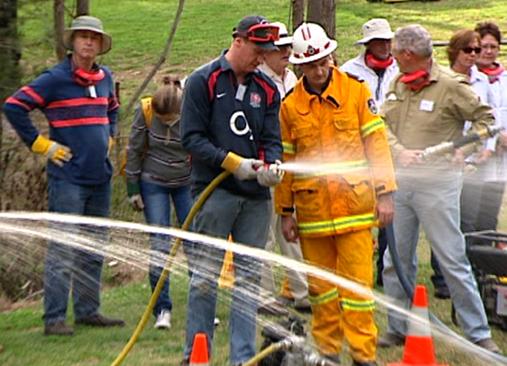
Kenthurst Rural Fire Brigade’s ‘Community Inclusion Programme’ encouraged the community to take responsibility for their own preparedness. A letter box drop is used to promote workshops that run through fire behaviour, preparing your property and Bush Fire Survival Plan, and includes a site visit to look at a prepared home and run through how to use pumps and hoses. This program includes live demonstrations so that participants can experience what radiant heat feels like, and practice techniques to put out fires. The Brigade prepared a DVD and has visited other brigades to share the program.

Canyonleigh Rural Fire Brigade's ‘Women’s Bush Fire Awareness Program’ encourages all brigade members to contribute and has now been running successfully for a few years. Workshops run through fire behaviour, preparing yourself and your property, hands on skills training and property assessments in the following months.

The workshops are effective because of their hands-on nature. Women are expected to complete activities under stress created by loud noises, time pressure, heat and darkness, giving them a taste for what it will be like to make a decision when there is a fire. This multi-award winning transfers skills to the community, with an emphasis on warmth, welcome and follow-up with participants.

Wollombi Rural Fire Brigade’s ‘Community Preparedness Program’ consists of workshops (including one for women only) followed up by a Firewise cafe, where people are introduced to the risks of bush fire,the importance of preparing a Bush Fire Survival Plan and factors they need to consider when deciding whether to Leave Early or Stay and Defend. Follow-up surveys have found that 94% of attendees completed a Bush Fire Survival Plan or felt they had sufficient knowledge to complete one following the workshop. A core feature is robust planning and adaptation to local needs. The brigade strongly supports shared learnings and the program contains a strong element of evaluation.

Otford Rural Fire Brigade’s ‘Urban Interface Program’ is cleverly marketed as pre-incident planning. The program includes bowling hoses, intelligence gathering and community engagement all rolled into one. All brigade members are involved and improves their knowledge of property access and defendability. This is an ongoing program for the Otford Brigade who plan to visit the majority of properties in the area. Residents are encouraged to take responsibility for their own property, complete a Bush Fire Survival Plan and ensure their property has suitable access. The program has been shared with other brigades and improves brigade familiarisation with the area.

07 March 2012

Reminder: Conference registrations close 16 March


Get in quick smart to register to attend the 2012 Australian Community Engagement & Fire Awareness Conference.


Registrations close Friday 16 March i.e. next week!


For more information and to complete our online registration form go to - http://bit.ly/hdXIs8.


Kind regards,


Community Engagement Team

Community.engagement@rfs.nsw.gov.au

02 8741 5416

28 February 2012

Great variety of abstracts received for our 2012 Community Engagement Conference RFSFireup2012 http://ow.ly/i/tTme

20 February 2012

Get your conference abstracts in: Closing this Friday


Just a friendly nudge…


This Friday (24 February) is the deadline to submit abstracts (i.e. to run a 45 min workshop) for the 2012 Australian Community Engagement & Fire Awareness Conference.

We know from previous years’ feedback that attendees particularly enjoy hearing from others within the service. If you or a member you know are considering a submission feel free to contact me for more information or to bounce ideas around.


For the submission form go to - http://bit.ly/hdXIs8


Below are some FAQs that have arisen throughout the process of collecting abstracts.
FAQs:

• Abstracts are an application to present a 45 minute workshop session at the conference. A number of sessions run simultaneously throughout the conference.

• Abstract submissions will be considered for keynote speakers.

• Submissions are reviewed and ranked by a Working Party comprised of NSW RFS members representing all four Regions.

• It is acceptable to share presenting duties with another NSW RFS member, however, we ask you to indicate this somewhere within your submission.

• If you have particular AV/IT or room set up requirements, please include this information in your submission.

• The conference program will be released after abstracts are assessed and speakers confirmed.

• You do not have to attach your presentation (PowerPoint or handouts) with your application.


If you have any questions don’t hesitate to get in touch – community.engagement@rfs.nsw.gov.au or 02 8741 5416.

Kind regards,


Nicole
Nicole Miller
Community Engagement Coordinator
Community.engagement@rfs.nsw.gov.au
02 8741 5416

01 February 2012

Registrations Open: 2012 ACE&FA Conference


Registrations to attend the 2012 Australian Community Engagement & Fire Awareness Conference are now open!

The conference this year will once again be held in sunny Wollongong at the Novotel Northbeach from the 31st May – 2nd June 2012.

Registrations close on 16th March 2012.

As you all know, the theme for this year is FIRE UP ENGAGEMENT! – focusing on strategies for improving and enhancing internal stakeholder engagement, participation and involvement in community safety. FIRE UP ENGAGEMENT! will provide an opportunity for delegates to share community engagement strategies, programs and projects that assist our work with communities to improve resilience before, during and after a natural disaster.

Due to venue capacity restrictions, the number of conference attendees is capped. After this date you may still submit an online registration form but you will be placed on the reserve list and your attendance cannot be guaranteed.
This year all registrations will need to be completed online. Click on the below links to submit your registration.

Staff 

Volunteer Members - All registrations will be reviewed by CSO/DTZ Managers so please make sure you talk to your CSO or Manager about your intent to register before submitting an online registration form.

If you have any questions please call Community Engagement team on (02) 8741 5416 or email Community.Engagement@rfs.nsw.gov.au

We look forward to seeing you in Wollongong!

Kind regards,


Community Engagement Team
NSW Rural Fire Service
(02) 8741 5416


06 January 2012

Go on, show off!


Have you thought about submitting an abstract for the 2012 Australian Community Engagement & Fire Awareness Conference? Last year’s attendees told us they especially liked hearing other volunteers speak.

Abstract submissions are expressions of interest to present one of our workshop streams (which run for approximately 45 minutes) or you may like to submit a poster or short video. All submissions will be reviewed by a Working Party of volunteers who will help us shape the conference program.

Why don’t you share your successes? What have been the biggest challenges and how did you overcome them? Any programs that are working well?

If public speaking gives you the horrors, why don’t you share the duties with another volunteer? This site has some great public speaking tips - http://bit.ly/9qgLbY.

Get cracking as the deadline is 24 February. For more information and the abstract paperwork go to http://bit.ly/hdXIs8.

Online registrations (to attend the conference) will take place soon. Standby for more information. Once the form is posted we’ll let you know.

Kind regards,


Nicole Miller

Community Engagement Coordinator

NSW Rural Fire Service

Community.engagement@rfs.nsw.gov.au

13 December 2011

2012 Conference Working Party Announced


We are pleased to announce the members of the 2012 Australian Community Engagement & Fire Awareness Conference Working Party.


Region East
• Gary Walker – Gosford District
• Anton Arathoon – Hills District/North Rocks Brigade
• Hugo Floriani - Hornsby/Ku-Ring-Gai Support Communications


Region South
• John Taubman – Lake George Zone, Wamboin - Palerang Brigade
• Robin Philp - Bega Valley District, Bega Valley/Eurobodalla Team, Brogo Brigade


Region West
• Kevin Heerey - Region West, Mid West Team, Hay HQ Brigade


Region North
• Nicole Vidler - Northern Rivers, Ellangowan/Support Brigade


These members have a wealth of community engagement experience and we look forward to ‘picking their brains’ regarding speakers, the program, and the ranking of abstracts. Members will meet via teleconference and will be of great assistance to the Community Engagement Team here in HQ.


 We’d like to thank everyone who submitted an application to join the Working Party. We appreciate the time taken to do so and for sharing your experiences.


Thanks to the Community Safety Officers (CSOs) and staff that helped us to assess the applications.


A quick reminder – We are now calling for conference abstracts, posters and video submissions. The deadline is 24 February 2012. For more information and to download an application form go to - http://bit.ly/hdXIs8


Kind regards,


Nicole

Nicole Miller
Community Engagement Coordinator
NSW Rural Fire Service
community.engagement@rfs.nsw.gov.au